IESCO Bill Check Online
IESCO — the Islamabad Electric Supply Company — supplies electricity to Islamabad, Rawalpindi, Attock, Jhelum and Chakwal. Whether you live in an Islamabad sector, a Rawalpindi mohalla or a Chakwal village, you can check your IESCO bill online in under a minute using the 14-digit reference number printed on any previous bill. Your bill opens on the official PITC portal, showing the payable amount, due date and units consumed — particularly useful for tenants and landlords in the twin cities, who often need to confirm that a bill has been paid before it is due.
Check Your IESCO Bill
Enter your 14-digit reference number below and press the button. You will be taken to the official IESCO bill page on the PITC portal, where you can view, download and print your current bill. This website does not collect or store your reference number.
14 digits, printed at the top of every IESCO bill. This site stores nothing.
Where Is the Reference Number on an IESCO Bill?
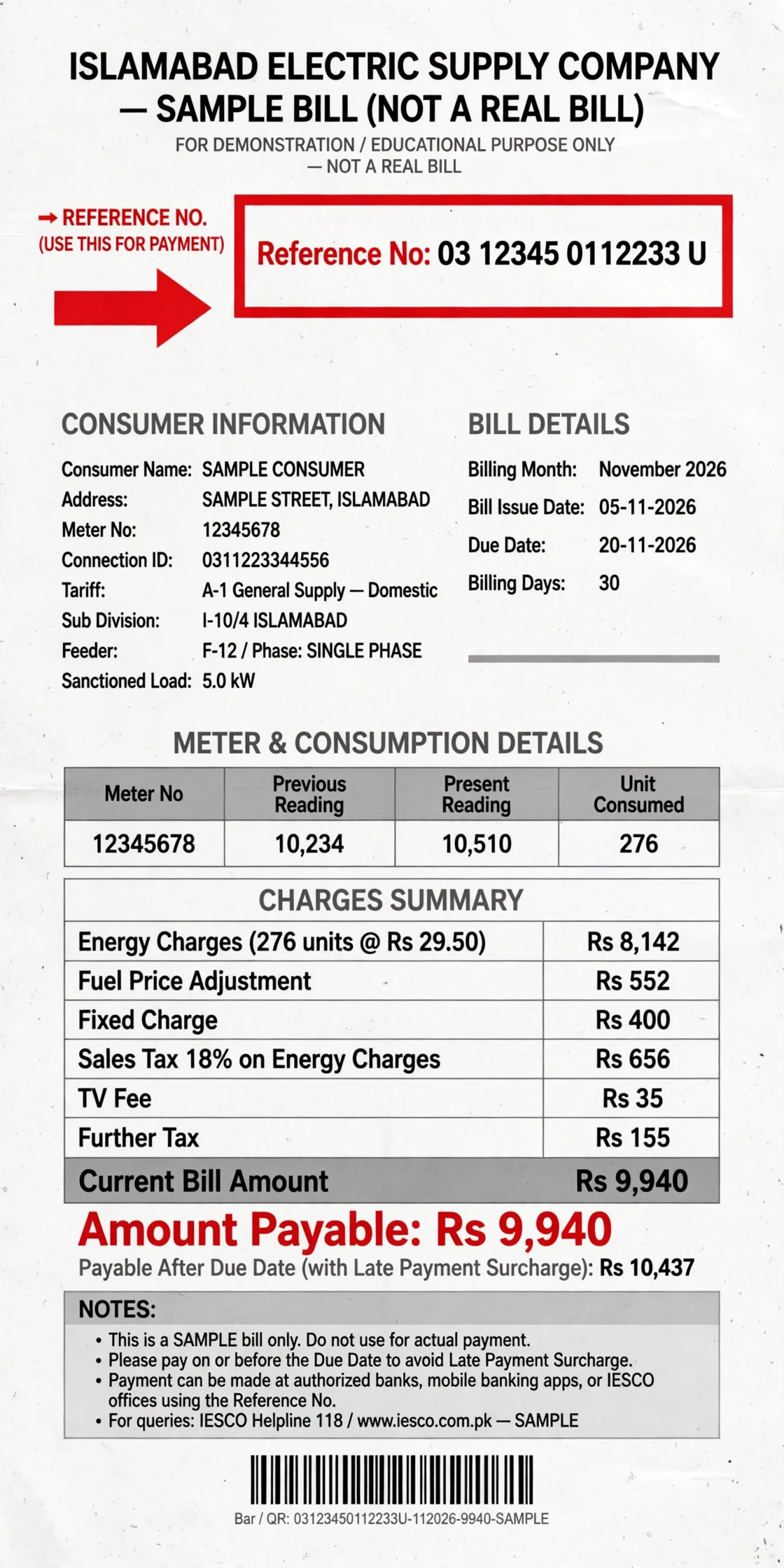
The reference number is printed near the top of every IESCO bill, labelled “Reference No”. It has 14 digits, often ending in U (urban) or R (rural): the first 2 digits are your billing batch, the next 5 your sub-division code, and the last 7 identify your connection. One IESCO-specific point: IESCO has renumbered connections in the past, and its own website offers a reference-number search to find a new number from an old one — so if a very old reference number is rejected, check for an updated number before assuming the portal is at fault. Do not confuse the reference number with the meter number stamped on the meter.
How to Check Your IESCO Bill — Step by Step
- Take any old IESCO bill and note the 14-digit reference number near the top.
- Enter it in the box above and press the button — the official IESCO page on the PITC portal opens.
- Confirm the reference number on the portal and submit. Your current bill loads on screen.
- Check the amount payable within the due date, the amount after the due date, and this month’s units.
- Print the bill or save the PDF — this duplicate is valid for payment and as an address proof.
Tenants and Landlords: How IESCO Bills Work in the Twin Cities
A large share of IESCO’s consumers are tenants — students near the universities, families posted to Islamabad on transfer, and young professionals in Rawalpindi’s rented portions. The connection, and therefore the bill, stays in the property owner’s name, so the monthly routine that works is simple: the tenant checks the bill online with the reference number as soon as it is issued, pays it through a wallet or bank app, and sends the landlord the paid PDF or screenshot. At the end of a tenancy, the same online check protects both sides — the landlord can confirm no arrears are outstanding on the connection, and the tenant has dated proof of every payment. One warning for portion houses: where several families share one meter through sub-meters, the IESCO bill is a single amount for the whole connection, and dividing it is a private arrangement between the households — IESCO will not split it, and disputes are best settled by photographing all sub-meters on reading day.
IESCO Duplicate Bill
The bill on the portal is the official bill itself. Print it or save the PDF and pay at any bank branch, post office, Easypaisa or JazzCash agent — no stamp is required. In Islamabad and Rawalpindi, landlords commonly ask tenants for the paid IESCO bill each month, and the portal PDF with its payment stamp from the bank or wallet app is the simplest proof to share.
Check Your IESCO Bill by SMS
Without internet, send “PITC” followed by a space and your 14-digit reference number to 8118. You will receive a reply with your current bill amount and due date. Standard SMS charges apply.
How to Pay Your IESCO Bill
Pay through any bank’s mobile app or ATM, Easypaisa, JazzCash, or over the counter at a bank branch, post office or authorised payment shop. Pay the “within due date” amount before the printed due date; after it, the higher amount including the late payment surcharge applies, and continued delay can lead to disconnection.
What You Are Paying For: The Parts of an IESCO Bill
The headline amount on an IESCO bill is built from several distinct pieces. The energy cost is your units multiplied by your slab rate — small “protected” households (at or below roughly 200 units a month) pay the cheapest rates, while heavier use moves the whole consumption into costlier slabs. On top of that sit the Fuel Price Adjustment, which passes through changes in generation fuel costs with a lag of about two months; quarterly tariff adjustments; fixed charges that apply even at zero usage; and a layer of government levies — sales tax, provincial electricity duty, the Rs 35 TV licence fee and the small Neelum Jhelum surcharge per unit. Consumers who are not income-tax filers may also see an advance income tax line once a bill passes the legal threshold. Reading these lines in order — units, slab, adjustments, taxes — is the fastest way to tell whether a high bill is a usage story, a tax story, or a genuine error.
Estimated Bills, Locked Premises and Reading Day
IESCO’s meter readers record readings on scheduled routes, and modern readings are captured with a photograph of the meter. If your gate is locked, the meter is inside, or the reader cannot reach the meter on reading day, the bill may be issued on an estimated or average basis and corrected in a later month — which is why a surprisingly low bill is sometimes followed by a heavy one, as the actual reading catches up. You can protect yourself by learning your reading date (it repeats monthly), keeping the meter accessible, and noting the kWh figure yourself on that date. If the printed reading and your meter disagree, the dated photograph is the evidence every complaint channel will ask for first.
Moving House, and Closing an IESCO Connection
When you move within Islamabad or Rawalpindi, the electricity connection does not move with you — it belongs to the premises. As a tenant, your job is to clear the final bill up to your leaving date (check it online on the day you hand over the keys, since a pro-rated settlement with the landlord is far easier then than a month later). Owners selling a property should have the buyer apply for transfer of the connection into the new name at the sub-division office with the sale documents, CNICs and the last paid bill; until the transfer is recorded, arrears remain attached to the connection, not to the person who used the electricity. A permanent disconnection — for a demolished or merged property — is also applied for at the sub-division office, and the final bill should be kept as proof of closure.
Solar and Net Metering in the IESCO Region
Rooftop solar has spread quickly across Islamabad’s sectors and Rawalpindi’s housing societies, and IESCO consumers with an approved net-metering licence sell their surplus units back to the grid. A net-metered bill looks different from a normal one: alongside the units you imported from IESCO, it shows the units your system exported, and the two are settled against each other before the payable amount is calculated — which is why a solar household’s bill can fall to little more than the fixed charges and taxes in a sunny month. If you are considering solar, the licence and the bi-directional (green) meter come first, through IESCO’s net-metering process; an unapproved system feeding the grid is treated as a billing irregularity. Net-metered consumers should still check the bill online every month, because export readings are the first place a metering fault shows up.
IESCO Areas and Helpline
IESCO covers the Islamabad Capital Territory and the Rawalpindi, Attock, Jhelum and Chakwal districts. For billing or supply complaints call 118, the nationwide electricity helpline, or visit your IESCO sub-division office — its code is the middle five digits of your reference number. If your reading looks wrong, photograph the meter with the date visible and complain before the due date.
Frequently Asked Questions
How can I check my IESCO bill online?
Enter your 14-digit reference number in the checker above. It opens your bill on the official PITC portal (bill.pitc.com.pk/iescobill) with the amount, due date and units consumed.
Can I check my IESCO bill by CNIC or name?
No. An IESCO bill can only be retrieved by its reference number (the portal also accepts the Customer ID printed on the bill). No genuine service shows a bill by CNIC, name or address alone.
My old IESCO reference number is not working. Why?
IESCO has renumbered some connections, so a very old number may have been replaced. IESCO’s website offers a reference-number search to find the new number from the old one; you can also call 118 or visit your sub-division office.
Is the online IESCO bill valid for payment?
Yes. The portal bill is the official bill, and its printout or PDF is accepted as a duplicate bill at banks, post offices and mobile wallet agents.
When does the new IESCO bill appear online?
After meter reading in your area, usually a few days before the paper bill arrives. Until the new bill is issued, the previous month’s bill remains visible on the portal.
We share one IESCO meter between two portions. How do we divide the bill?
IESCO issues one bill for the whole connection, so the division is between the households. The fairest method is to read both sub-meters on the same day as the main reading and split the bill in proportion to the units each portion used, including a matching share of the fixed charges and taxes.
My tenant left with unpaid IESCO arrears. Am I responsible?
The arrears stay attached to the connection, which is in the owner’s name, so the owner must clear them to keep the supply running. This is why landlords should check the bill online every month during a tenancy rather than only when the tenant leaves.
Why did my IESCO bill arrive as ‘estimated’ this month?
An estimated bill is issued when the meter could not be read — a locked gate or an inaccessible meter is the usual reason. It is normally corrected automatically when the next actual reading is taken; if it is not, complain on 118 with a dated photograph of your meter.
I have solar panels. Why is my IESCO bill not zero?
Net metering settles your exported units against the units you drew from IESCO, but fixed charges, taxes and duties still apply, and in cloudy weeks or heavy night-time usage your imports can exceed your exports. The bill’s import and export lines show the exact balance for the month.
Other Electricity Companies
Not an IESCO consumer? Check your LESCO bill (Lahore region) or MEPCO bill (Multan and South Punjab), estimate any bill with our electricity bill calculator, or see current per-unit rates on our unit price page. Every company is listed on our homepage.